


A useful skill isn’t automatically a service I should sell.
People sometimes ask if I can help with video editing or other creative work alongside their website. It is a fair question. Different creative skills often overlap, and a business owner understandably wants to know who can help.
I don’t offer standalone video editing as part of my current service. My focus is websites and web development: helping people explain their business, present their work and give customers a clear next step.
A video may belong on a website. That does not make producing and editing videos the same service as designing the site around it. Each deserves its own attention, process and standard of work.
I want my offer to be clear enough that you know what you are hiring me for.
Focus should make the service better for you.
From a client’s perspective, the important question is what I can deliver well and consistently. A longer list of services is useful only if the quality and attention are there to support it.
Focusing gives me a clearer place to invest my time: understanding how businesses describe their services, improving layouts, testing enquiry routes, reviewing mobile pages and planning what happens after launch.
Those details are connected. The wording needs to match the service. The button needs to lead somewhere useful. The website needs to work on the device your customer is holding.
I would rather spend my working time improving that whole experience than keep expanding a service menu simply because I could accept another kind of job.
You can explore my website projects to judge the work for yourself.
Doing everything has a cost beyond the extra hours.
Different services bring different briefs, tools, revisions and expectations. The cost is more than the time spent doing the additional work. It includes the attention required to keep changing direction.
There is research behind that narrower point. In experiments on arithmetic and visual-classification tasks, Rubinstein, Meyer and Evans found measurable switching-time costs, with greater costs for more complex rules. These were laboratory tasks, so the research does not prove that a business with several services will perform badly. It does help explain why changing tasks is not frictionless. Read the original task-switching study.
My decision is a business judgement: I want a clear core offer and enough attention to deliver it properly.
Being focused doesn’t mean a business can never grow.
A well-run agency can offer several services through people who specialise in different areas. Some businesses also have strong reasons to offer related services. A broad offer does not automatically mean average work.
For a small business or a person delivering the work themselves, though, it is worth asking whether every extra service strengthens the main promise or simply makes the business harder to run.
A focused business can still learn, improve and add capacity. It can work with specialists when a project needs them. It can expand when there is a clear reason and a credible way to maintain quality.
The aim is to be known for something you do particularly well, with an offer customers can understand.
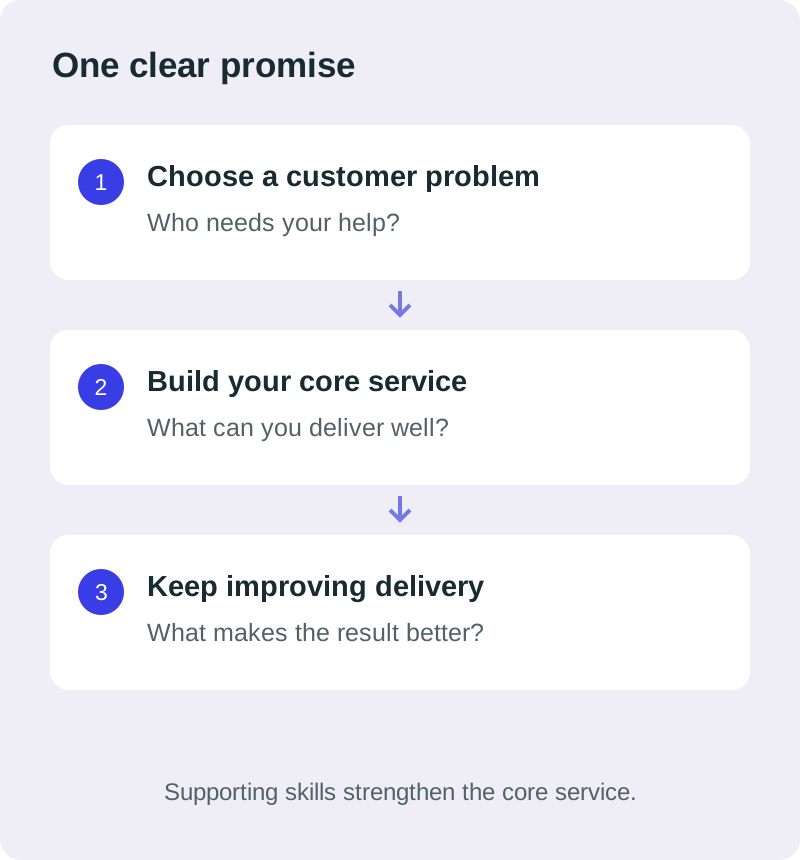
Choose the problem you want to become excellent at solving.
If you are a business owner, try writing one sentence: ‘We help this kind of customer solve this problem.’ Then look at your service list and ask:
- Which service most directly delivers that promise?
- Which work deserves more practice, better systems or more attention?
- Which requests would be better handled by someone else?
- Can a customer understand your main offer without a long explanation?
You will still have several responsibilities as a business owner. Focusing your offer does not remove sales, admin or customer care. It gives those activities a clearer purpose.
For me, that purpose is helping businesses get a useful website online. My article on AI and hiring a designer explains the judgement involved in that work.
If you need a website, that is the conversation I want to have.
Tell me what your business does, who you want to reach and what you need the website to achieve. We can agree the scope and work towards a free initial preview before you decide whether to proceed.
If you are still shaping the brief, use the website preparation checklist. You can also read why a website can become a useful business asset.
For project examples and an overview of working together, explore my London web design guide for small businesses.