

AI is already part of how I work.
If you can ask an AI tool for a website and see a working starting point quickly, it makes sense to question what you would be paying a designer to do.
I use AI tools and a library of templates to speed up the starting point myself. That helps me offer an initial preview without charging you to see the direction. I am not asking you to believe that every part of a website must be made slowly by hand.
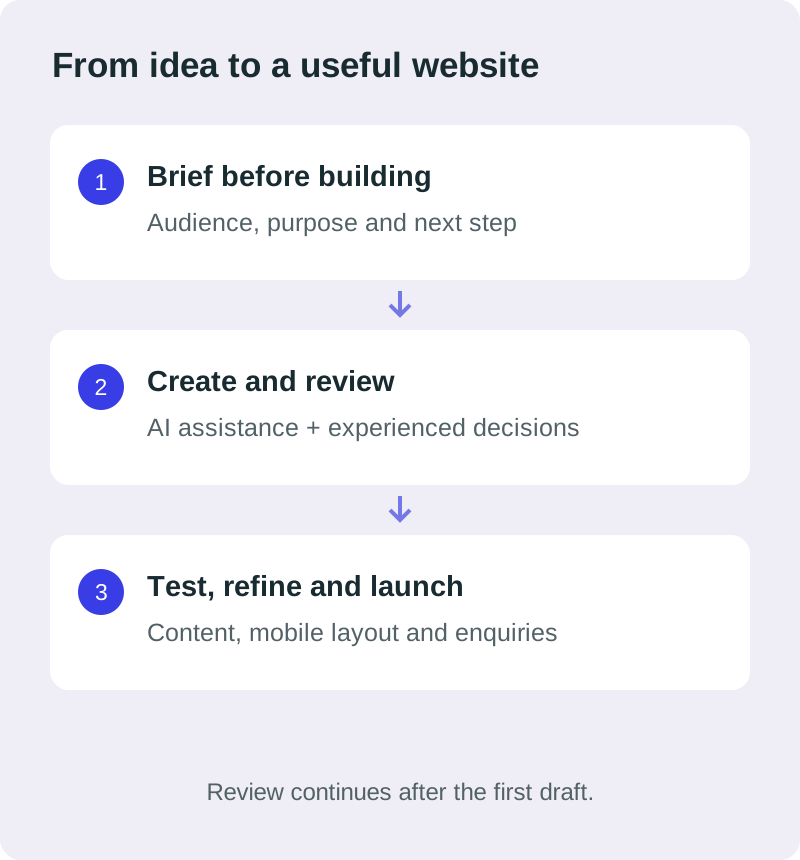
The value I need to add is in understanding the brief, making useful decisions, shaping the result and checking it before you rely on it.
If you enjoy the tools, have the time and have straightforward requirements, building your own site can be a reasonable choice. An honest explanation of my service should leave room for that.
A generated page still needs decisions.
A website can look finished while leaving important questions unanswered. Is the main service obvious? Does the wording describe your business accurately? Can someone find the price information they need? Does the enquiry route work as expected?
For a service business, a button labelled ‘Get in touch’ could open an email app, lead to a form or send someone to a booking service. Those choices affect the visitor’s experience. They need to be agreed and tested.
The same applies to editing access, hosting, mobile layouts and the content you want to add later. A convincing first screen does not settle the whole brief.
The guide to editing your website shows why one of those decisions is worth making before the build begins.
My experience helps me ask better questions earlier.
I bring more than 10 years of experience to the work. That matters when it helps me identify a confusing message, question an unnecessary feature or notice that the page is asking the customer to do too much.
Experience should show up in decisions you can understand: which information appears first, how services are organised, what needs its own page and what the visitor should do next.
You can see different examples in my website project collection. An academy explaining a programme and an athlete-representation business introducing its approach have different audiences. The site should reflect those differences.
I would want you to assess my work and process, rather than choose me because of the number of years alone.
Your time is part of the cost.
The time spent generating a first layout is only part of a website project. There is also choosing what to say, supplying the right information, reviewing the result, connecting services and checking what happens when someone uses it.
If that work takes evenings away from running your business, it belongs in your comparison. So does paying someone to untangle a setup later because the original decisions were unclear.
Your competitors can access similar tools. That makes the quality of the decisions, the usefulness of the information and the experience after the first impression worth taking seriously.
Getting the direction right early can reduce avoidable rework. It does not mean a preview will need no changes. Reviewing and refining the site are part of how we get to an agreed result.
Review and testing still matter.
GitHub’s own guidance for its AI coding agents tells users to review and test generated code. It also explains that generated output can fail to match the intended requirement. That is a specific warning about coding tools, not evidence that every AI website builder produces a poor website. It supports the practical point that output needs checking. Read GitHub’s responsible-use guidance.
There is also evidence that details visitors experience can affect business outcomes. In a Vodafone landing-page A/B test reported by web.dev, the version with improved loading performance generated 8% more sales. That was one company’s test, not a forecast for your business or a claim about my results. It illustrates why performance can deserve attention beyond the visual design. Read the Vodafone case study.
Choose the route that gives your business the right support.
If you can confidently plan, build, review and maintain the website yourself, DIY may suit you. If you want help making those decisions and getting the site ready to use, that is where an experienced designer can add value.
My approach starts with your business and a free initial preview. We confirm the scope and costs before you choose to proceed. The website costs guide explains the current offer, and the updates guide covers support after launch.
Why I focus on websites explains how I choose to deliver that service. If it sounds useful, request your free website preview and judge the direction for yourself.
For project examples and an overview of working together, explore my London web design guide for small businesses.